※This page was translated by AI from the original Japanese version. There may be differences in wording or nuance, so please refer to the Japanese original for the most accurate information.
In the small town in rural Fukuoka where I lived for many years, rice fields stretched all around us. I even helped friends plant and harvest rice. I still fondly remember wading through the mud during planting season and the sound of combine harvesters carrying across the fields in the autumn sunlight.
I now live in a regional city in South Korea. When I see the kind of rice fields I was used to in Japan, with water shimmering across them and seedlings lined up in neat rows, I often stop to take a look. When I sent a photo to my sister in Japan, she replied, “You could mistake it for Japan just from the photo.”

In Korean, a rice paddy is called 논 (non). In the area where I live, most of the rice planting had finished by late May one year. It seemed a little earlier than the June planting I was used to in Fukuoka. But a friend who used to grow rice told me that early varieties are planted in Fukuoka as early as the beginning of May. Planting times vary by region, variety, and cultivation method.
I sometimes see farm machinery in Korea with “KUBOTA” written on it, a familiar name in Japan. Even little things like that make me feel at home.

I don’t usually think of myself as someone who cares much about food, but I do think, “It would be tough if I couldn’t eat good rice.” Luckily, I enjoy rice every day here in Korea, too. I’m grateful to the farmers!
Living in Korea has made me think about rice again. How is Korean rice different from Japanese rice? I looked into what might explain the differences in how they taste, and here’s what I found.
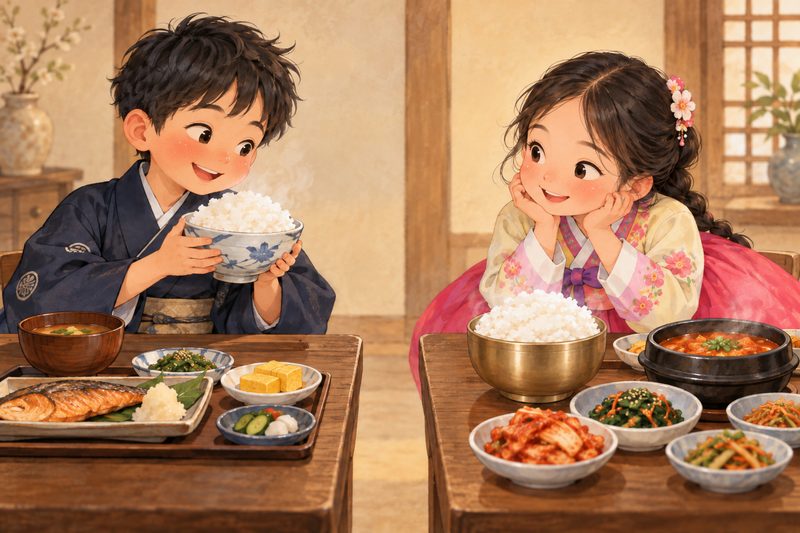
Some Koreans find Japanese rice delicious, too
Some time ago, I took my wife’s nephew, who was in middle school, on a trip to Japan. It was his first time there.
After we got back, I asked him, “What was the best thing you ate in Japan?” Without a moment’s hesitation, he answered, “Rice!”
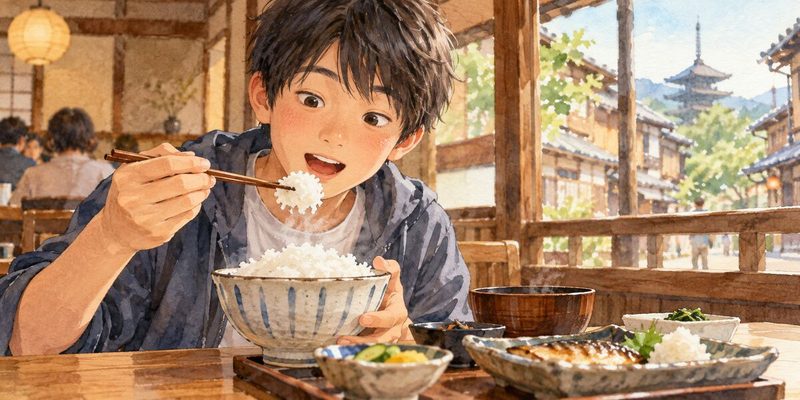
Not sushi or ramen, but plain white rice. The rice he ate in Japan must have made quite an impression on him.
He isn’t the only one. Some people in Korea also say they enjoy the taste of Japanese rice.
In 2017, a column appeared in a Korean newspaper about how good the rice at Japanese restaurants and in bento boxes tasted. It discussed topics such as rice quality control, milling methods, and fertilizer use in Japan. Source: JoongAng Ilbo Japanese edition, March 22, 2017
In 2026, another report quoted a Korean chef praising the texture and flavor of Japanese rice. Source: JoongAng Ilbo Japanese edition, May 21, 2026
Rice grown in Korea is also mainly japonica rice, the same broad type grown in Japan. Japonica rice has short, rounded grains and tends to become soft and slightly sticky when cooked. In other words, Japan and Korea mainly eat the same type of rice.
So why do people sometimes notice a difference in taste?
What accounts for the difference in taste between Japanese and Korean rice?
Taste is partly a matter of personal preference. I enjoy Korean rice myself. As I looked into the subject, I found that several factors may affect how rice tastes.
How protein affects the taste of rice
Protein content is one factor that can affect how rice tastes.
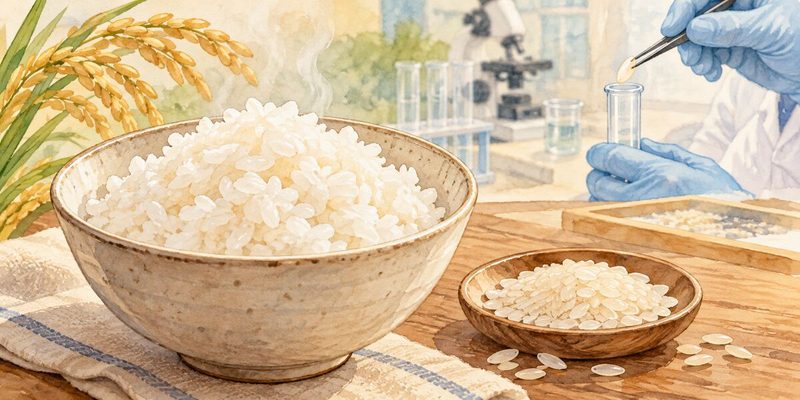
According to Japan’s Ministry of Agriculture, Forestry and Fisheries, rice with a higher protein content generally tends to receive lower taste evaluations. One possible reason is that more protein can make it harder for the starch to absorb water and soften during cooking. As a result, the cooked rice may be firmer and less sticky.
Since soft, sticky rice is preferred in Japan, rice with a lower protein content may be more likely to suit Japanese tastes. Source: Japan’s Ministry of Agriculture, Forestry and Fisheries, “Scientific Evaluation of Rice Taste”
A 2024 study of japonica rice in China’s Yangtze River Delta also found that, among rice samples with similar amylose content—a component of starch—those with more protein received lower taste evaluations. South Korea’s National Agricultural Products Quality Management Service also explains that rice with less protein tends to taste better when cooked. Source: Study on starch, protein, and the eating quality of japonica rice (2024, in English) / South Korea’s National Agricultural Products Quality Management Service
Of course, lower protein content does not automatically mean better-tasting rice. The variety, starch characteristics, storage conditions, and cooking method can all affect the taste.
Protein content alone cannot tell you how good rice will taste. Still, it may be one useful thing to check if you like soft, sticky rice.
Grain condition and quality standards
The condition of the individual grains is another point to consider when thinking about the taste of rice.
Studies have reported that broken or chipped grains absorb water faster than whole grains and tend to collect at the bottom of the pot after cooking. If there are many broken grains, they may affect the texture of the cooked rice. Source: Japan Society of Home Economics, “Behavior of Broken Rice Grains Produced During Washing While Cooking”
In Korea, rice is graded according to the amount of broken grains and other factors. There is also a label that indicates how much of the rice consists of grains that are whole and undamaged.
Japan also has a system for inspecting rice and assigning grades, but the items inspected and the standards differ from those in Korea.
The 2017 column mentioned earlier compared Korean and Japanese rice at the time and discussed quality control in Japan. Because the article is several years old, its description may not reflect the situation today. It does, however, point to the possibility that rice quality depends not only on variety and composition, but also on grain condition and quality control. Source: JoongAng Ilbo Japanese edition, March 22, 2017
I explain these details in “Buying Rice in Korea: How to Choose and Cook Korean Rice.”
Low-temperature storage of rice
Rice quality also changes depending on storage temperature and humidity. How rice is stored after harvest is an important part of keeping it fresh and tasty.
In Japan, rice is often stored in low-temperature warehouses kept at 15°C or below, with humidity around 70–75%. Rice can also be stored as paddy rice or brown rice. Managing temperature and humidity in this way helps slow the loss of quality and preserve the rice’s flavor for longer. Source: Minna no Nōgyō Hiroba, “Rice Storage”
Low-temperature storage facilities for rice are also increasing in Korea. According to South Korea’s Ministry of Agriculture, Food and Rural Affairs, the number of low-temperature warehouses used to store government-managed rice and other grains rose from 161 in 2016 to 1,095 in March 2023. Since 2022, milled rice managed by the government has also been required to be stored at low temperatures. Source: Korea Policy Briefing (in Korean)
I could not find data on how much rice in private distribution is stored at low temperatures. However, given the growth in low-temperature storage for government-managed rice, it may also be becoming more common in the private sector.
Differences in how people eat rice and what they like
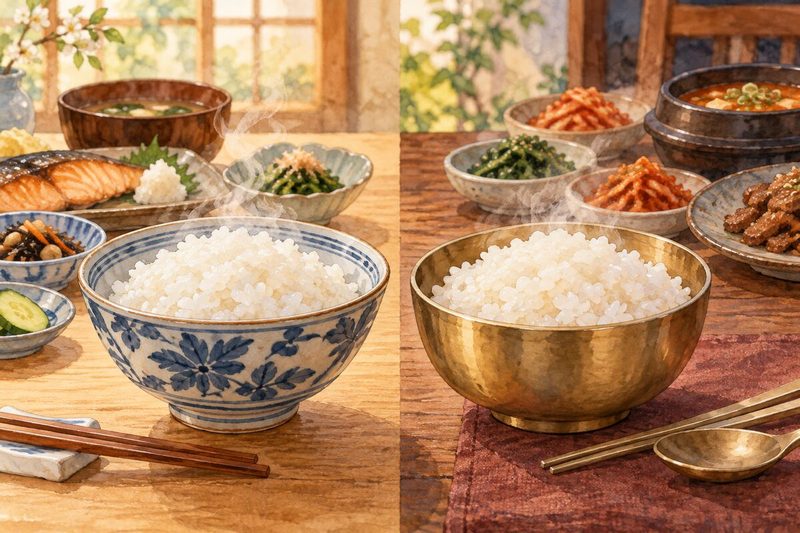
In Japan, people often say that a good side dish “makes you want to eat more rice,” or talk about “rice accompaniments.” I’m the type who likes to eat plenty of plain rice with my side dishes.
Once, I ordered tonkatsu at a restaurant in Korea and felt that the rice portion was too small. I wrote about some of the small differences in Japanese food served in Korea in an earlier article, “Japanese Food in Korea That Isn’t Quite Japanese: Tonkatsu and Udon.”
From what I have seen, not that many people order rice at Korean barbecue restaurants. I don’t order it very often in Korea either; I usually go for cold noodles instead. In Japan, I used to love eating meat with rice at yakiniku restaurants.
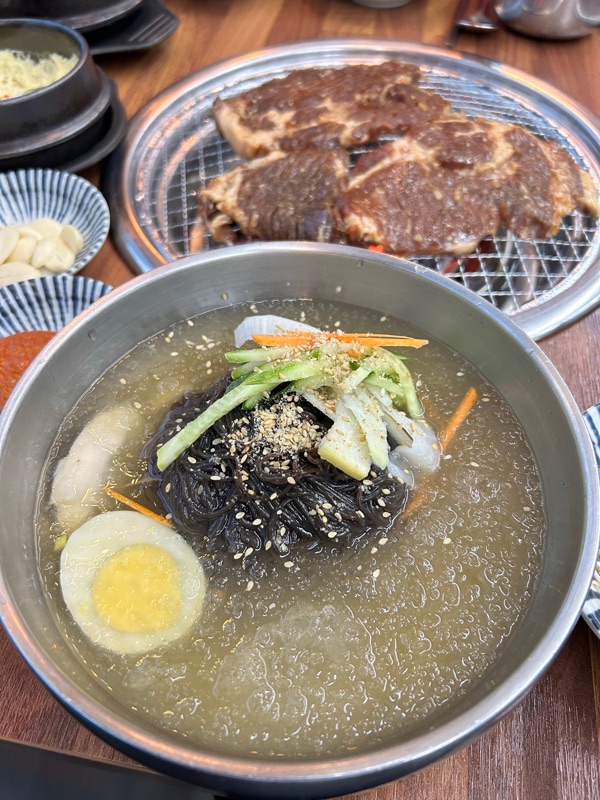
At the restaurants I visit, noodles are often another option besides rice, and it doesn’t seem unusual for people not to order rice. Of course, rice is also an important staple in Korea, and serving sizes and eating habits vary by dish and restaurant. Still, my impression is that, unlike in Japan, rice is often treated as something to eat alongside the main dishes.
In Japan, where people often eat plain rice on its own, perhaps they also tend to pay more attention to its flavor. The difference in how rice is served may affect how people evaluate its taste, but that is only my own guess.
Summary: Factors that affect how rice tastes
From what I found, several factors seem to affect the taste of rice:
- Protein content
In general, rice with less protein tends to become softer and stickier when cooked. - Condition of the grains
Broken or chipped grains absorb water differently from whole grains and may affect the texture of cooked rice. - How rice is stored after harvest
Low-temperature storage can help slow the loss of rice quality. - Food culture and personal preference
People eat rice in different ways and have different ideas about what makes it taste good.
Of course, many other factors affect the taste of rice. And based on what I found, it is not clear how much these differences influence the taste of Japanese and Korean rice. Still, they may offer some clues to help us think about why the taste can seem different.
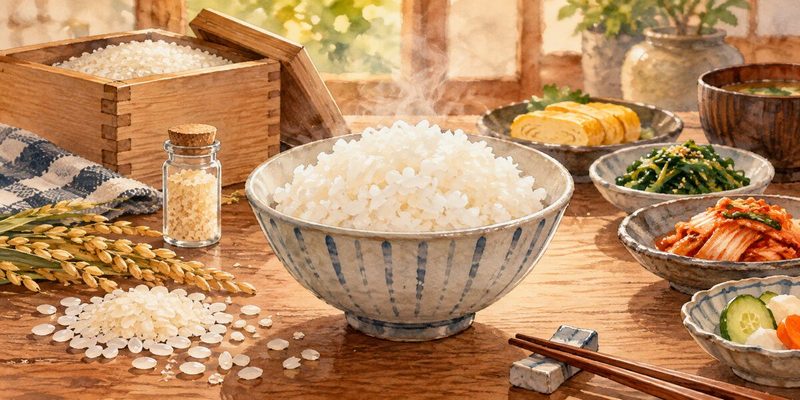
Thinking fondly of the rice fields in Fukuoka, I enjoy another bowl of rice here in Korea today. I hope there is always delicious rice on your table, too.
So, what should you look for when buying rice in Korea? I cover some helpful tips in this article. ↓

References
- Scientific Evaluation of Rice Taste (Ministry of Agriculture, Forestry and Fisheries of Japan)
- Behavior of Broken Rice Grains Produced During Washing While Cooking (Japan Society of Home Economics)
- Rice Storage (Minna no Nōgyō Hiroba)
- A Column on the Taste of Japanese Rice (JoongAng Ilbo Japanese edition, March 22, 2017)
- A Korean Chef’s Comments on Japanese Rice (JoongAng Ilbo Japanese edition, May 21, 2026)
- Effect of starch and protein on eating quality of japonica rice in Yangtze River Delta (PubMed, 2024, in English)
- 양곡표시제 (Grain Labeling System) (National Agricultural Products Quality Management Service of Korea, in Korean)
- Government grain warehouses are being systematically managed, with insurance against fires (Korea Policy Briefing, August 24, 2023, in Korean)