※This page was translated by AI from the original Japanese version. There may be differences in wording or nuance, so please refer to the Japanese original for the most accurate information.
One of the things that surprised me when I moved to Korea was just how many Japanese restaurants there were.
You see sushi restaurants, ramen shops and izakaya-style pubs not only in major cities but also in smaller towns. Alongside the chains are plenty of little independent places, each with its own personality. It’s fun to explore them.
But when I eat Japanese food in Korea, I sometimes find myself thinking, ‘Wait, this is a little different from what I’d get in Japan.’ Two prime examples are tonkatsu and udon.
In fact, Korean-style tonkatsu, which initially surprised me, has become something I crave from time to time. I really have grown to love it! (Haha.)
The names are familiar, but the appearance, flavors and even the way you eat them can be a little different. Here, I’d like to share what I’ve experienced eating tonkatsu and udon in Korea, and how they compare with their Japanese counterparts.
- Japanese Food Is Hugely Popular in Korea
- Are Udon and Tonkatsu Practically Korean Food Now?
- Korean-Style Tonkatsu: Thin, Huge and Different from Japan
- Try an Oversized ‘Wang Tonkatsu’ at Namsan in Seoul
- When You’re Craving Thick Japanese-Style Tonkatsu
- How Is Korean Udon Different from Japanese Udon?
- Useful Korean Words for Ordering Food
- Final Thoughts: Enjoy Japanese Food with a Korean Twist!
- References
Japanese Food Is Hugely Popular in Korea
Japanese food has become a familiar part of everyday life in Korea.
According to a survey published by Japan’s Ministry of Agriculture, Forestry and Fisheries in November 2025, Korea had approximately 19,800 Japanese restaurants, the third-highest number in the world after China and the United States. (China had about 63,500 and the U.S. about 26,360.)
These are approximate figures for establishments recognized locally as Japanese restaurants; they are not all necessarily owned by Japanese people. Even so, it’s fascinating to see just how widespread Japanese food has become in Korea.
Living in Korea, I often see people enjoying Japanese anime, films and music. Some cafés and restaurants also feature dishes with Japanese names or Japanese-inspired presentation. I often catch myself thinking, ‘Ah, they’re going for a Japanese feel here.’
Korean dramas sometimes feature characters having a drink with Japanese dishes as snacks, or enjoying a quiet conversation in a cozy Japanese restaurant. Watching those scenes makes me wonder whether Japanese food has become not just ‘foreign food’ but a style or atmosphere in its own right.
Are Udon and Tonkatsu Practically Korean Food Now?
What’s interesting is that some dishes brought over from Japan have evolved in their own ways to suit Korean food culture.
In Korea, udon (うどん)is called ‘udong (우동),’ while tonkatsu(とんかつ) is commonly called ‘donkkaseu (돈까스).’ The standard Korean spelling for the latter is ‘돈가스,’ although ‘돈까스’ is also commonly seen on restaurant signs and menus.
This seems to be because Korean doesn’t have a sound that corresponds exactly to the Japanese ‘つ(tue)’ in ‘tonkatsu.’
I once told my wife’s nephew, who was in middle school at the time, that udon and tonkatsu originally came from Japan—and that the Korean names ‘udong (우동)’ and ‘donkkaseu (돈까스)’ also come from Japanese words.
He was genuinely surprised.
To him, they must have felt like foods that had always been around. His reaction reminded me just how deeply dishes introduced from Japan have become part of Korea’s own food culture.
From Japan to Korea: Familiar Dishes, New Appeal
Tracing tonkatsu back to its roots takes us to European cutlet dishes. The dish developed into something distinctly Japanese before making its way to the Korean Peninsula as well.
According to the Academy of Korean Studies’ Encyclopedia of Korean Culture, tonkatsu became a standard offering at Korean ‘gyeongyangsik (경양식)’ restaurants, which served Western-style food. A typical version features a large, thin cutlet covered in sauce and eaten with a knife and fork.
Udon also took root in Korea and developed local variations, such as ‘garak-guksu (가락국수),’ which uses anchovy-based broth. Records show that Japanese udon was already being eaten on the Korean Peninsula in the first half of the 20th century. I’ll return to garak-guksu later in the article.
It’s amazing how a dish can cross the sea and take on the distinctive flavors of a new place. That’s one of the things I love about food culture.
Korean-Style Tonkatsu: Thin, Huge and Different from Japan
The first thing that struck me when I saw Korean-style tonkatsu was its size.
It was enormous!
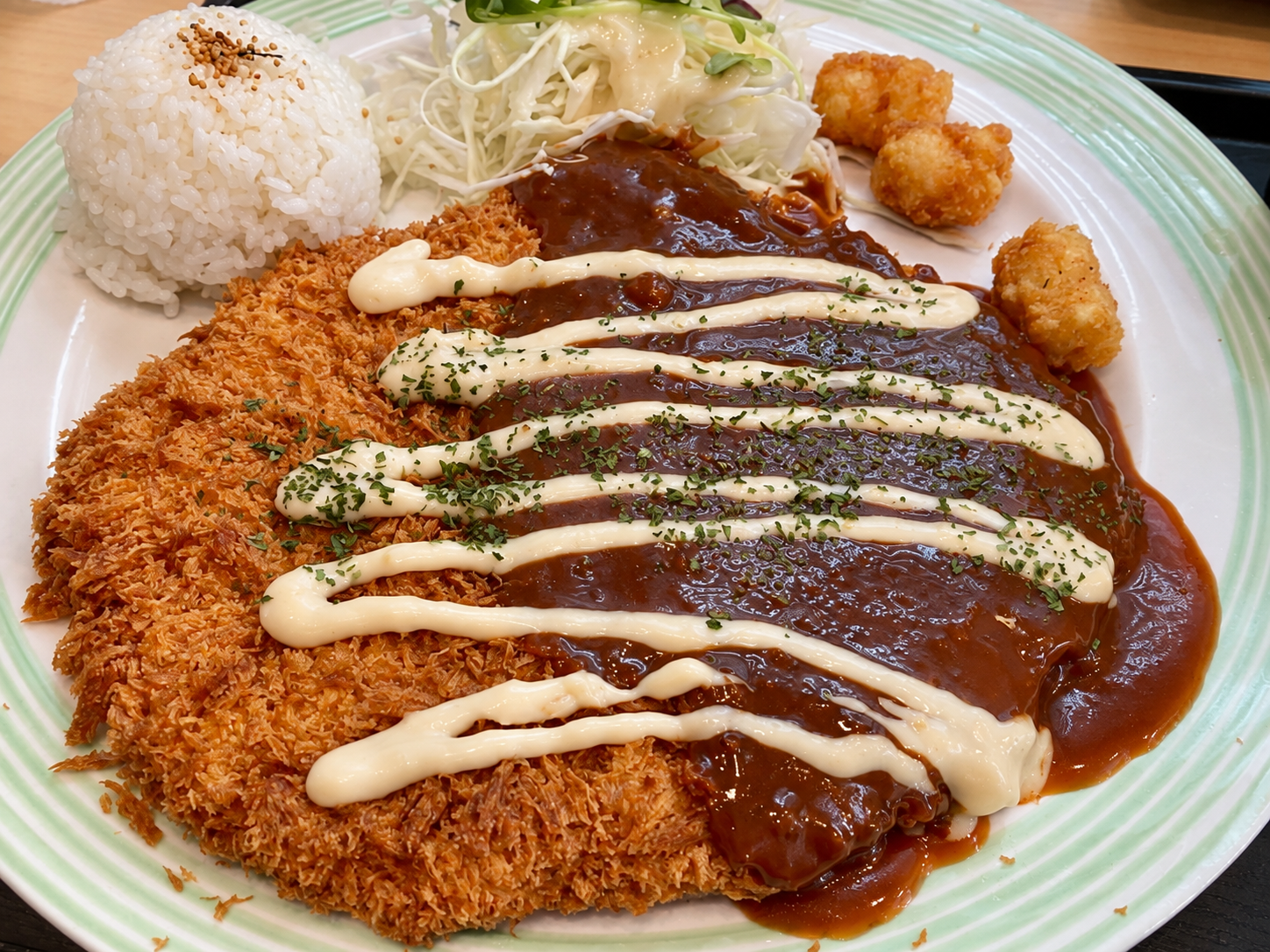
The traditional Korean-style version is made by pounding the meat thin and wide before frying it. It may be thin, but it certainly takes up a lot of space on the plate.
Mild Sauce and a Generously Loaded Plate
The coating is fried until crisp, then covered with plenty of sauce. The versions I’ve eaten tasted less salty than the tonkatsu sauce I’m used to in Japan, with a mild, creamy flavor.
Alongside shredded cabbage, the plate might come with rice and soup, and sometimes even Napolitan-style spaghetti, pickles or kimchi. It’s practically an ‘everything on one plate’ meal.
The cutlet itself is so substantial that I’m usually quite full by the end.
Cut It Yourself with a Knife and Fork
Another difference is how you eat it. In Japan, tonkatsu is often served pre-sliced. The traditional Korean version, however, usually comes as one large piece that you cut yourself with a knife and fork.
At first, I found it a little inconvenient, but I’ve come to enjoy it. Somehow, it feels like eating a classic Western-style meal.
A Huge Cutlet, but Hardly Any Rice?!
The size of the tonkatsu wasn’t the only surprise. The rice portion caught me off guard too.
Not because there was a lot of it—but because there was so little!
In Japan, restaurants often serve a generous bowl of rice separately. With a Korean-style one-plate meal, you may get just a little mound of rice at the edge of the plate.
I felt slightly disappointed the first time. But the cutlet was so filling that, by the end, I thought, ‘Actually, maybe that was just enough.’ (Haha.)
I also talk about the food cultures of Japan and Korea through the lens of rice in A Familiar Landscape of Rice Fields: Exploring Rice Culture in Japan and Korea.
Korean-Style vs. Japanese-Style Tonkatsu
| Feature | Traditional Korean style | Japanese style |
|---|---|---|
| Meat | Pounded thin and spread wide | Often relatively thick |
| Sauce | Served with a Western-style sauce on top | Often served with tonkatsu sauce added to taste |
| How it’s eaten | With a knife and fork | Often pre-sliced and eaten with chopsticks |
| Presentation | Rice and sides on the same plate | Set meal with rice and miso soup served separately |
It’s surprising how different two dishes with the same name can be, isn’t it?
Try an Oversized ‘Wang Tonkatsu’ at Namsan in Seoul
If you’re looking to try Korean-style tonkatsu in Seoul, the area around Namsan is worth exploring. Known for N Seoul Tower, Namsan also has a cluster of tonkatsu restaurants.
One is 101 Beonji Namsan Donkkaseu (101번지 남산돈까스). Its signature dish is ‘Namsan Wang Donkkaseu (남산왕돈까스).’
This is the flagship location of a chain with more than 100 branches nationwide, including outlets at highway rest stops and shopping-mall food courts. The restaurant’s name comes from the address of its flagship location: 101 Sopa-ro, Jung-gu, Seoul (서울 중구 소파로 101).
On Korean restaurant menus, you’ll sometimes see dishes with ‘wang (왕)’ in their names. It often means ‘large’ or ‘extra-large,’ as in ‘wang donkkaseu (왕돈까스)’ or ‘wang mandu (왕만두),’ a large dumpling.
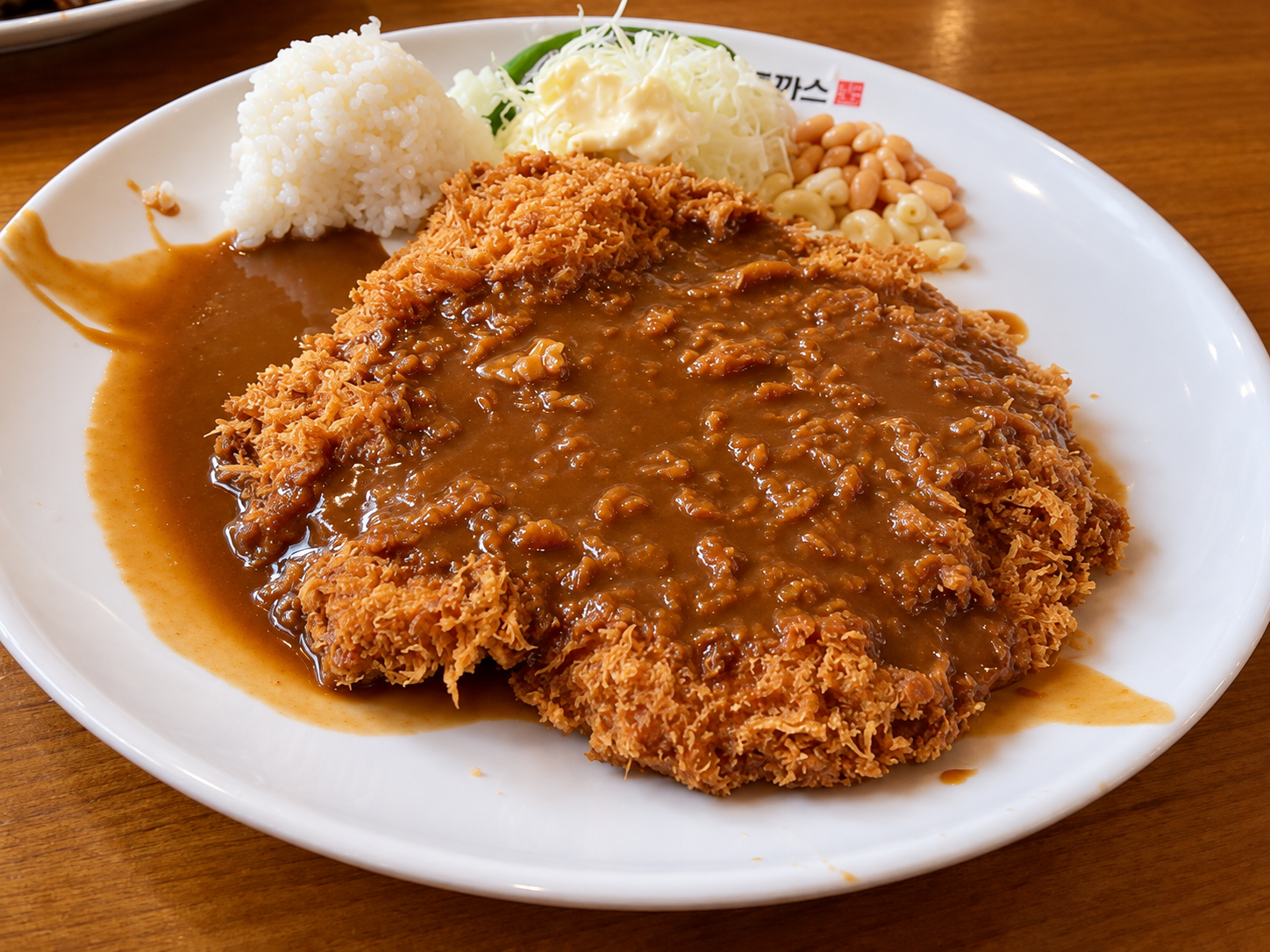
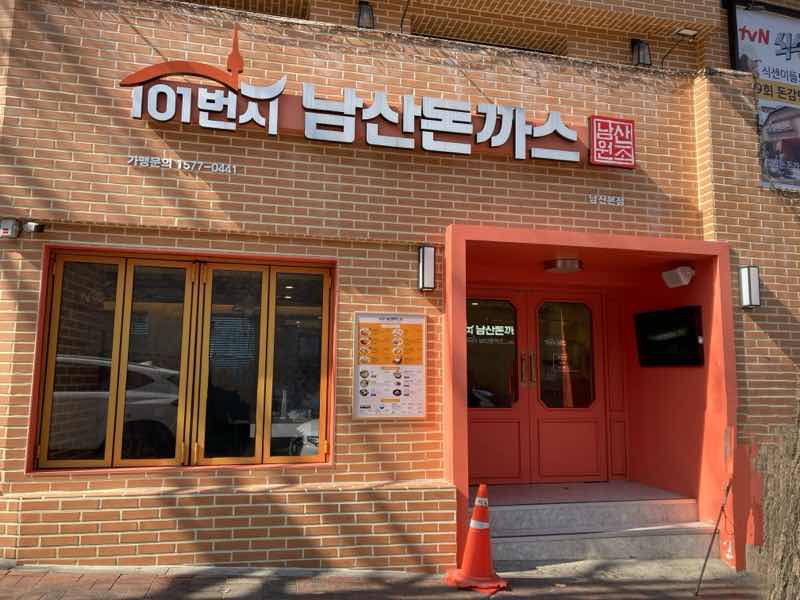
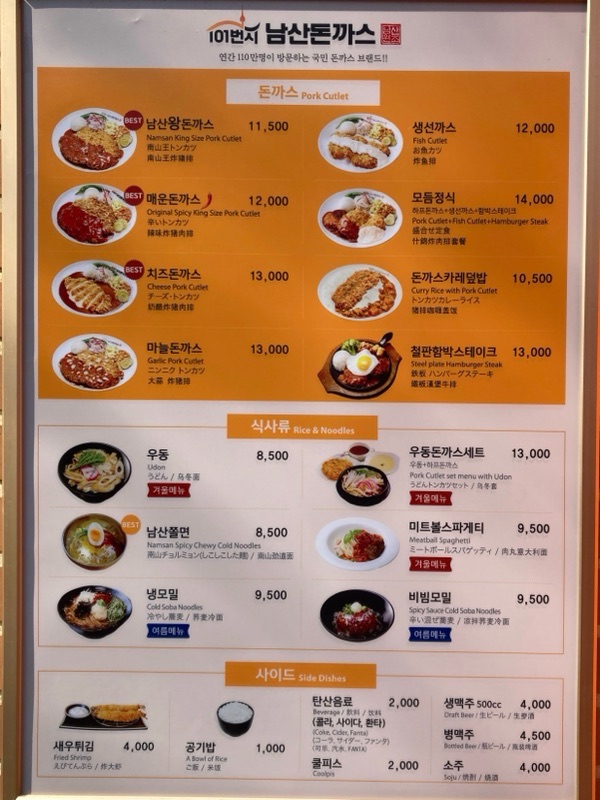
The current official website also lists Namsan Wang Donkkaseu, cheese tonkatsu, spicy tonkatsu, udon and other dishes.
101 Beonji Namsan Donkkaseu — Namsan Main Branch
Address: 101 Sopa-ro, Jung-gu, Seoul (서울 중구 소파로 101)
Access: About a 15-minute walk from Myeongdong Station on Subway Line 4.
Price guide: Namsan Wang Donkkaseu ₩13,900; Cheese Donkkaseu ₩14,900 (prices listed on a restaurant information site, checked in October 2026).
101 Beonji Namsan Donkkaseu official website (Korean)
※ Routes and travel times depend on where you start. Menus, prices and opening hours can change, so check the latest details before visiting.
When You’re Craving Thick Japanese-Style Tonkatsu
I love Korea’s oversized cutlets, but sometimes I miss the thick-cut tonkatsu I’d have in Japan.
Fortunately, there are restaurants in Korea that serve Japanese-style tonkatsu too. It’s nice to have the choice between two different styles.
Tonkatsu at Baeksojeong (백소정)
One place to enjoy Japanese-style tonkatsu is Baeksojeong (백소정).
This chain serves pork loin cutlets, cheese cutlets and more, and has several branches around Seoul. It’s convenient to find one near wherever you’re exploring.
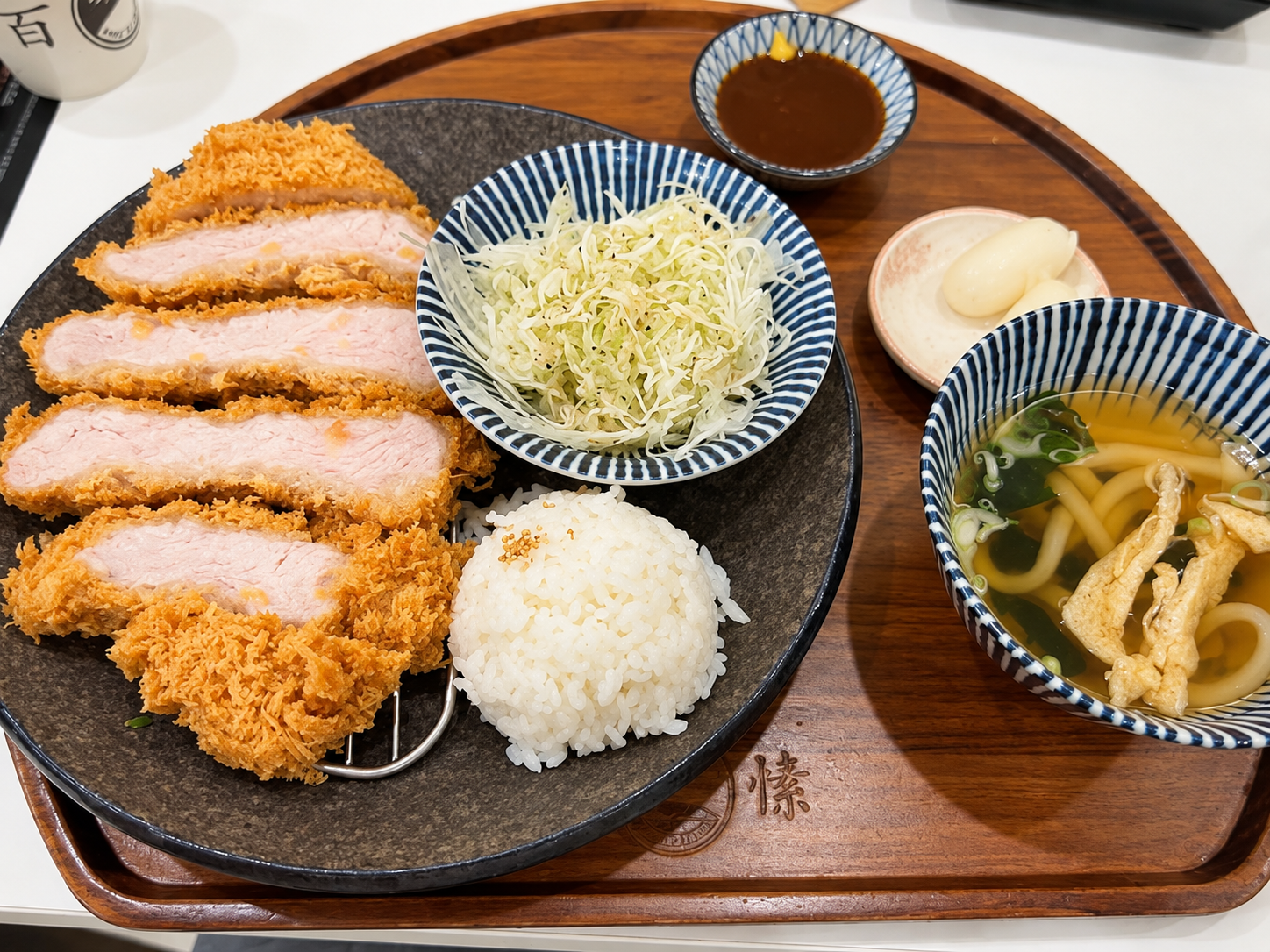
I took this picture during an earlier visit. The cutlet was Japanese-style, but something about the way the rice was served still felt distinctly Korean.
Baeksojeong official website (Korean)
※ Menus and opening hours may differ by branch.
A branch near Seoul Station ↓
Japanese Restaurant Chains You Can Also Find in Korea
Several Japanese restaurant chains familiar to people in Japan have also opened in Korea.
These include Sushiro, Marugame Seimen, MOS Burger and CoCo Ichibanya, among others.
I’ve written separately about the Curry House CoCo Ichibanya restaurants in Korea.
Reunited with Curry House CoCo Ichibanya in Korea!
When I’m craving Japanese curry, it’s a welcome option. And yes, you can get tonkatsu curry there too.
How Is Korean Udon Different from Japanese Udon?
Another dish that sometimes tastes noticeably different in Korea is udon.
It may look similar to Japanese udon, but one sip of the broth can make me think, ‘Hmm, this isn’t quite the flavor I know.’
In Korea, some udon dishes use anchovy-based broth, while others are made spicy with kimchi. Of course, you can also find udon made with kombu (kelp) or bonito flakes, so flavors vary from one restaurant to another.
Garak-Guksu (가락국수): Udon with Anchovy Broth
An interesting dish to explore when looking into the history of Korean udon is garak-guksu (가락국수).
According to the Academy of Korean Studies’ Encyclopedia of Korean Culture, this Korean-style udon is known for its broth made with ingredients such as dried anchovies. The encyclopedia also describes its history as a convenient meal for train travelers, particularly around Daejeon Station.
Today, it’s also widely sold at highway rest stops.
Japan has its own tradition of grabbing a quick bowl of udon at a railway station. I find it fascinating that Korea developed a similar food culture.
Kimchi Udon and Eomuk Udon Too!
You can also find variations like these in Korea.
- Kimchi udon (김치우동): Udon with kimchi, giving it a spicy, tangy flavor.
- Eomuk udon (어묵우동): Udon with eomuk, a Korean fish cake.
- Garak-guksu (가락국수): Korean-style udon noodles typically served in a broth made with ingredients such as dried anchovies.
The Korea Tourism Organization also features a kimchi udon recipe, using a broth made with dried anchovies, kombu and bonito flakes, with kimchi added.
Spicy udon is especially delicious on a cold day. It really warms you up.
Depending on the restaurant, toppings can include fried foods (sometimes closer to what Japanese diners might call a ‘fry’ rather than tempura), egg or even tteok (Korean rice cakes). You can come across some distinctly Korean combinations.
Udon I Actually Tried in Korea
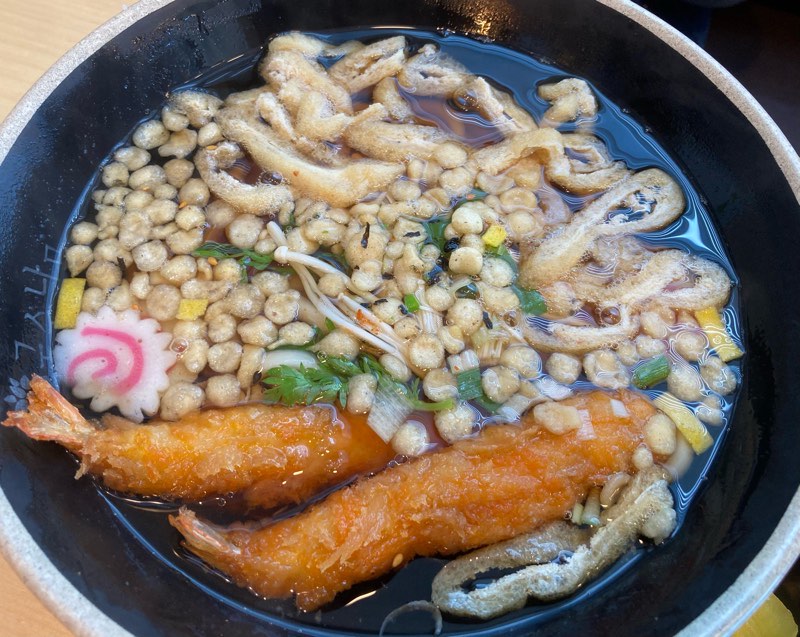
It looks similar to Japanese udon, but the broth has a slightly different character. If you expect the flavor you’re used to in Japan, you might be surprised.
But it’s delicious in its own way! Discovering these little differences is one of the pleasures of living abroad.
Useful Korean Words for Ordering Food
For readers who want to try these dishes while traveling in Korea, here are some Korean menu terms worth knowing.
| Korean | Approximate pronunciation | Meaning |
|---|---|---|
| 돈가스 / 돈까스 | don-gaseu / don-kkaseu | Tonkatsu (breaded pork cutlet) |
| 왕돈까스 | wang-donkkaseu | Oversized tonkatsu |
| 치즈돈까스 | chijeu-donkkaseu | Cheese tonkatsu |
| 돈카츠 | donkacheu | Sometimes used on menus to suggest Japanese-style tonkatsu |
| 우동 | udong | Udon |
| 김치우동 | gimchi-udong | Kimchi udon |
| 어묵우동 | eomuk-udong | Fish cake udon |
| 가락국수 | garak-guksu | Korean-style udon noodle dish |
To order one serving, add ‘하나 주세요 (hana juseyo)’ after the name of the dish. It means ‘One, please.’
For example, ‘돈가스 하나 주세요 (don-gaseu hana juseyo)’ means ‘One tonkatsu, please.’
Final Thoughts: Enjoy Japanese Food with a Korean Twist!
Tonkatsu and udon traveled from Japan to Korea. Although the names are the same, the seasoning, presentation and even the way you eat them can be different in Korea.
Of course, I sometimes miss the tonkatsu and udon I grew up with in Japan. But the Korean versions have their own appeal.
I’ve grown so fond of Korean-style tonkatsu that I regularly have days when I just have to eat it. That enormous cutlet, that generous helping of sauce—and even the tiny portion of rice that surprised me at first now feels completely normal! (Haha.)
If you visit Korea, I hope you’ll give these ‘Korean-style Japanese dishes’ a try. Comparing flavors is part of the fun of traveling, and food offers a great way to experience cultural differences firsthand.
Who knows? You might fall for the Korean versions just as I have.
References
- Japan’s Ministry of Agriculture, Forestry and Fisheries, ‘Approximate Number of Japanese Restaurants Overseas by Country and Region’ (2025)
- Academy of Korean Studies, Encyclopedia of Korean Culture, ‘Don-gaseu’
- Academy of Korean Studies, Encyclopedia of Korean Culture, ‘Udon’
- Korea Tourism Organization, ‘Kimchi Udon’ (Japanese)
- Korea Tourism Organization, ‘Kimchi Udon’ (English)