※This page was translated by AI from the original Japanese version. There may be differences in wording or nuance, so please refer to the Japanese original for the most accurate information.
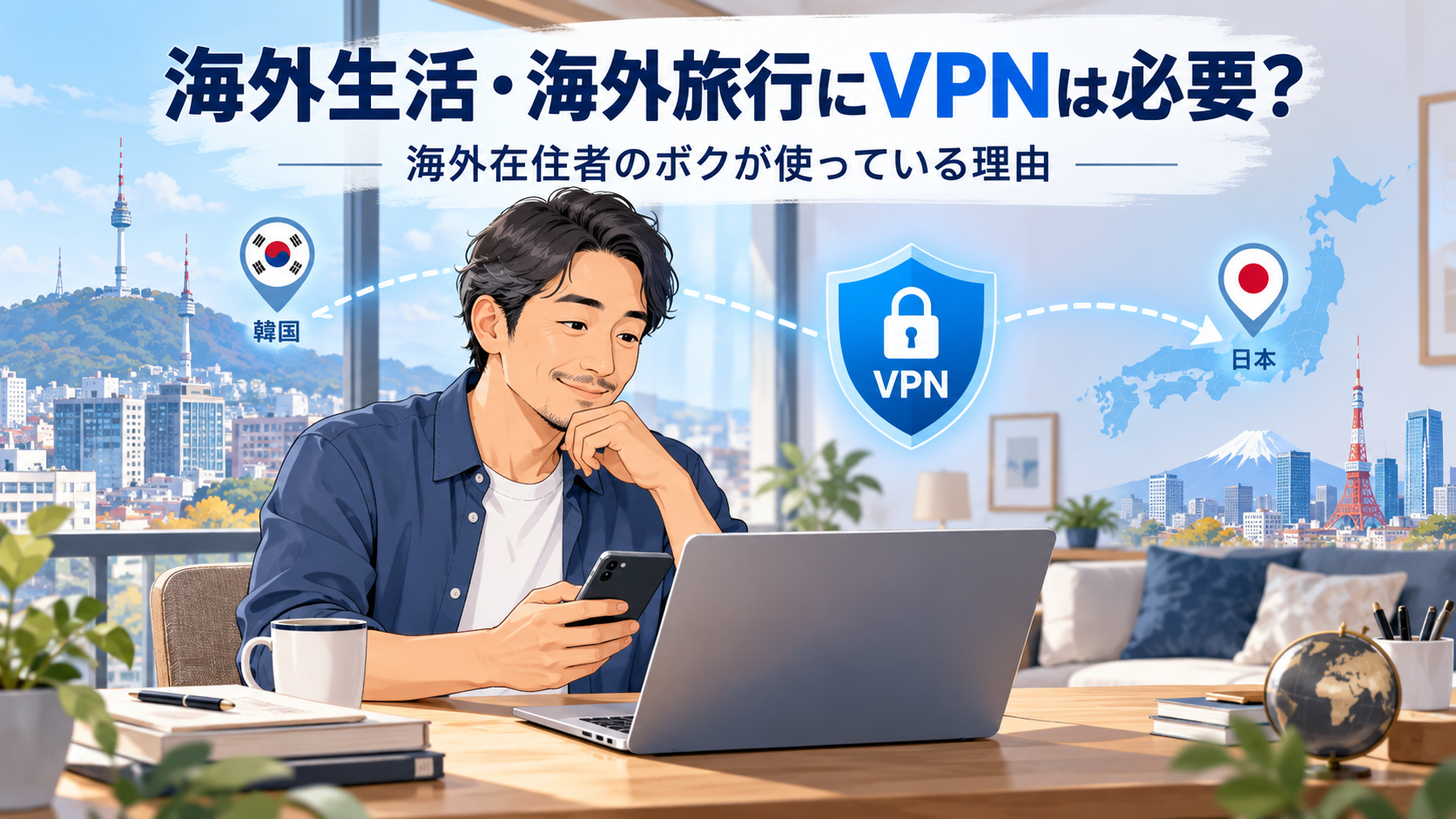
Since I started living overseas, one online service that has made me think, “I’m glad I have this,” is a VPN.
When people hear “VPN,”
“It’s something for people who know a lot about cybersecurity.”
“It’s something you use to watch Japanese TV from overseas.”
Some people may have that kind of image of a VPN.
But when you actually live overseas, you realize that a VPN can be useful for much more than that.
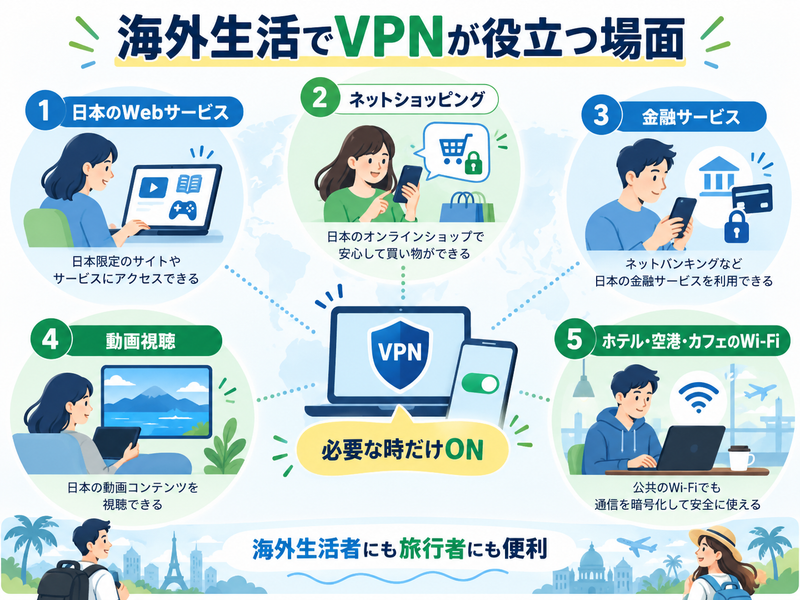
When using Japanese web services, shopping online, accessing financial services such as banks, watching videos, or using hotel or airport Wi-Fi while traveling.
A VPN can be useful in many different situations.
I currently live in Korea. I do not keep my VPN connected all the time, but I find it very reassuring to have a way to connect whenever I need to while living overseas.
In this article, I will explain as simply as possible what a VPN is and what benefits it can offer people living abroad and international travelers.
- What Is a VPN?
- Why a VPN Is Useful for People Living Abroad
- A VPN Is Useful for International Travelers Too
- However, Using a VPN Does Not Make Everything Safe
- For Life Abroad, a “Fixed IP” Is Another Option
- I Use a Fixed Japanese IP Address
- Summary | It Is Useful to Have a VPN You Can Connect to When Needed While Abroad
What Is a VPN?
VPN stands for “Virtual Private Network.”
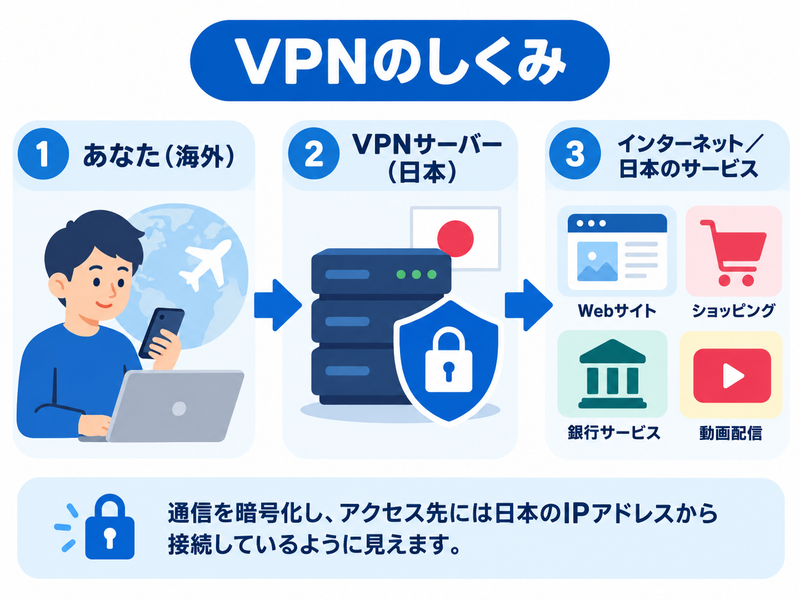
Simply put, it creates an encrypted communication path between your computer or smartphone and a VPN server.
For example, if you connect from Korea to a VPN server in Japan, your internet traffic flows like this:
You in Korea
↓
Encrypted connection through a VPN
↓
VPN server in Japan
↓
Internet
From the website you are accessing, it appears that you are connecting from the IP address of the VPN server, rather than directly from Korea.
Cloudflare also explains that a VPN encrypts your connection and replaces the IP address visible to the site you access with the IP address of the VPN server.
Why a VPN Is Useful for People Living Abroad
Even if you live overseas for a long time, your connection with Japan does not simply disappear.
In fact, once you start living abroad,
“I can’t use the internet the same way I did when I was in Japan.”
You may be surprised by how often you feel this way.
One reason is your **IP address**.
Web services can use information such as your IP address to determine, to some extent, which country or region you are accessing from. As a result, when you access services intended for users in Japan from overseas, some services may not work or may display different content.
If you connect to a VPN server in Japan, the service you access sees a Japanese IP address. This is one of the major advantages of using a VPN while living abroad.

When Using Japanese Web Services

I use Japanese online stores, check my Japanese bank accounts, and use web services intended for users in Japan.
Most of the time, I use my regular internet connection in Korea and turn on the VPN only when I need it to access a Japanese service.
Of course, many services work perfectly well even when accessed from an overseas IP address.
This does not mean that “you always need a VPN to access Japanese websites from overseas.”
That is not what I mean.
However, some services restrict access from overseas or treat it as an unusual login. In those situations, having the option to connect to a VPN server in Japan can be very helpful.
When Using Japanese Banks and Financial Services
For people living abroad, Japanese financial services can be an important concern. Many people keep bank accounts, credit cards, securities accounts, and other financial services in Japan.
I use Rakuten Bank from Korea.
Most of the time I can check my account without any problem using my regular Korean internet connection, but sometimes I cannot view my account information unless I connect to a VPN in Japan.
However, this is only **my personal experience in my own environment**.
It does not mean that “using a VPN will always make the service accessible.”
That is not what I mean.
Banks and other financial institutions evaluate security using multiple types of information, including not only IP addresses but also device information, authentication data, and usage history.
Rakuten Bank states that it offers an “IP Restriction Service,” which can restrict certain transactions made from IP addresses other than those registered in advance. This shows that IP addresses can be used as one of the security factors for financial services.
If you use a financial institution’s services through a VPN, make sure to check the company’s terms of use and security guidance in advance.

When Watching Japanese Video Content

I think Japanese video services are one of the most common reasons people living overseas first become interested in VPNs.
Some video streaming services restrict the countries or regions where they can be used because of copyright and distribution agreements. As a result, a service that worked normally in Japan may no longer be available once you go overseas.
When you connect to a VPN server in Japan, your access comes from a Japanese IP address. I also use a VPN when watching Japanese video content from Korea.
However, being technically able to access a service through a VPN and the service provider allowing that type of use are two different things. Some services do not support VPN use, while others set regional conditions in their terms of service.
Whether you can watch a particular video service can also depend on the VPN provider or type of VPN you use. The fact that a service works in my current environment only reflects the situation at the time of writing. Before using a service, check its terms and conditions.
A VPN Is Useful for International Travelers Too
VPNs are not only for people who live abroad. They can also be useful during a short overseas trip.
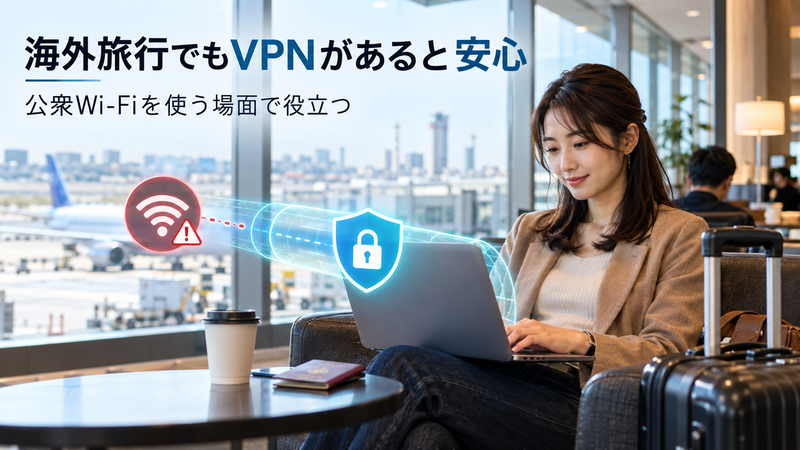
While traveling, you are more likely to use free Wi-Fi at places such as
airports
hotels
cafés
shopping malls
restaurants
.
Today, many websites use HTTPS encryption, so public Wi-Fi is safer than it used to be. The U.S. Federal Trade Commission (FTC) also explains that because most websites are encrypted, the risks of public Wi-Fi are lower than they once were.
Even so, public Wi-Fi itself is not necessarily safe. For example, someone can create a fake access point with a name that closely resembles the Wi-Fi network of a real hotel or café.
Japan’s IPA (Information-technology Promotion Agency) advises users to use a trusted VPN service when necessary when connecting to public Wi-Fi. The U.S. Cybersecurity and Infrastructure Security Agency (CISA) also urges people to be especially careful with activities such as online banking and online shopping when using public Wi-Fi at airports, hotels, and cafés.
If you need to use public Wi-Fi while traveling, a VPN can **encrypt the communication between your device and the VPN server**. For travelers, this can be one part of a broader security strategy.
However, Using a VPN Does Not Make Everything Safe
This is an important point.
Using a VPN does not protect you from every danger on the internet.
- If you enter your password into a phishing site yourself, the information can still be sent to the attacker even if you are using a VPN.
- You still need separate protection against viruses and malware.
- Because your traffic passes through a VPN, your internet speed may sometimes be slower than usual.
In addition, using a VPN means trusting the VPN provider with your internet traffic. Cloudflare also explains that VPN security depends on being able to trust the provider.
For that reason, I do not recommend choosing an unfamiliar VPN simply because it is free. When choosing a VPN, check points such as the following:
- Who operates the service, and what kind of company is it?
- What encryption method does it use?
- What does its privacy policy say?
- What kind of track record does the service have?
- Can you receive support in a language you are comfortable using?
For Life Abroad, a “Fixed IP” Is Another Option
If you live overseas for a long time, there is one more option worth knowing about: a fixed IP address.
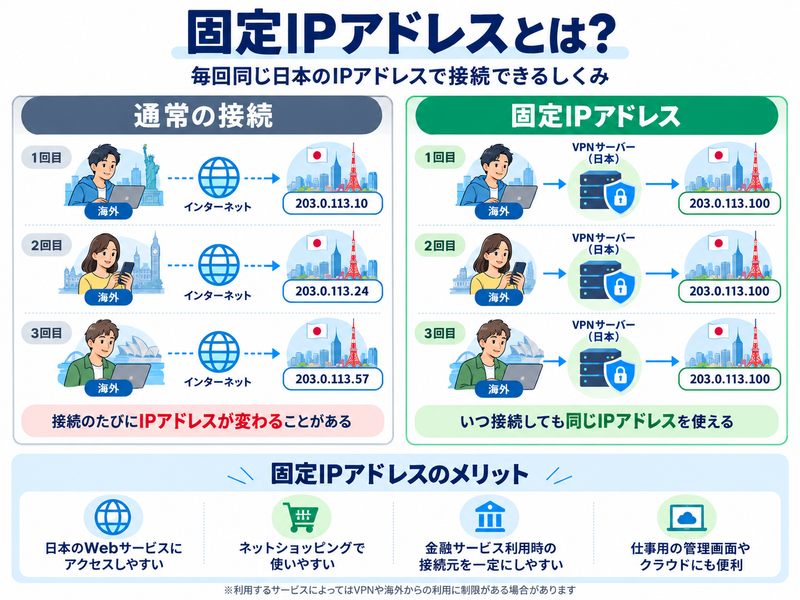
With a typical VPN, your IP address may change depending on the server you use or the connection conditions, even when you connect to a server in Japan.
With a fixed IP, however, you can use **the same Japanese IP address** every time you connect to the VPN.
For example,
when accessing a Japanese service today
when accessing the same service tomorrow
when connecting from your home Wi-Fi
when connecting from a different Wi-Fi network
if you connect through the VPN, you can use the same Japanese IP address.
This can be convenient for people who live overseas but continue to use Japanese online stores, financial services, membership sites, work-related services, and other services in Japan.
Of course, having a fixed IP does not mean that every Japanese service will become accessible. Even so,
“Being able to connect from the same Japanese IP address whenever I need to”
can be a surprisingly useful advantage when living overseas.
I Use a Fixed Japanese IP Address
This is also the type of service I use while living in Korea.
I use Glocal VPN’s “Easy Fixed IP Address” service.
I connect only when necessary for Japanese online shopping, financial services, web services intended for Japan, and Japanese video content. For my normal internet use in Korea, I do not use a VPN. I turn it on only when I need a Japanese internet connection.
Summary | It Is Useful to Have a VPN You Can Connect to When Needed While Abroad
For people living overseas, a VPN is not just a tool for watching Japanese television.
When you want to use a Japanese web service.
When shopping online.
When accessing Japanese financial services.
When using public Wi-Fi while traveling.
And when you want to watch Japanese video content.
It can be useful in many different situations.
Not everyone living abroad needs to keep a VPN connected 24 hours a day. However,
“Having the option to connect to a VPN when you need it”
is one reason I consider a VPN a reassuring tool for life overseas.
Even on a short overseas trip, if you plan to use public Wi-Fi at airports or hotels, having a VPN available can give you an extra layer of reassurance.
And if you live overseas long-term while continuing to use Japanese services, another option besides a standard VPN is to use a fixed Japanese IP address.