
※This page was translated by AI from the original Japanese version. There may be differences in wording or nuance, so please refer to the Japanese original for the most accurate information.
In my previous article, “Rice Culture and Taste in Japan and Korea: Reflections on a Nostalgic Paddy Landscape,” I wrote about how some people notice a difference in the taste of Japanese and Korean rice, and discussed four factors that may be related to that difference.
- Protein content
- Condition of the grains
- Storage after harvest
- Food culture and personal preference
This time, I’ll look at practical clues for choosing good-tasting rice in Korea: rice varieties, differences in quality standards and labeling systems, what to check on a rice package, and how to cook and store rice.
How do rice variety labels differ in Japan and Korea?
Many people check the variety name on a rice package when buying rice. In fact, Japan and Korea differ somewhat in how rice varieties are labeled.
In Japan, rice is labeled “single-origin rice” (単一原料米) when its place of origin, variety, and harvest year are all the same. In Korea, there is a label called “single-variety rice” (단일미), which can be used when at least 80% of the rice is from one variety. Source: Japan’s Ministry of Agriculture, Forestry and Fisheries, “Rice Labeling” / Gyeonggi Province’s explanation of rice labeling (2024, in Korean) / Ministry of Agriculture, Food and Rural Affairs notice on variety labeling (2020, in Korean)
In other words, even if a Korean rice package shows the name of one variety, it may not meet exactly the same conditions as Japan’s “single-origin rice” label.
Labeling also differs for rice made by mixing several varieties. In Korea, the package shows the proportion of each variety or uses the label “혼합” (mixed). In Japan, the rice is labeled “複数原料米” (rice made from multiple sources), and its place of origin and the proportion from each origin are shown. If supporting records are available, the variety and harvest year can also be shown along with the proportions.
Of course, rice is not necessarily bad just because it contains a blend of varieties. The taste can vary depending on which varieties are used and in what proportions. Knowing about these labeling differences may help when choosing rice in Korea.
Related source: Kids Hankook Ilbo article (in Korean)
How is rice quality managed? Standards and labeling in Japan and Korea
How is rice quality assessed in Japan and Korea? Both countries have standards for evaluating rice, but the systems are somewhat different.
Korea: “Special,” “Superior,” and “Regular” grades
In Korea, when non-glutinous rice (ordinary rice eaten with everyday meals, as opposed to glutinous rice) is packaged and sold, its quality grade must be shown. This grading system relates to the “condition of the grains” discussed in the previous article.
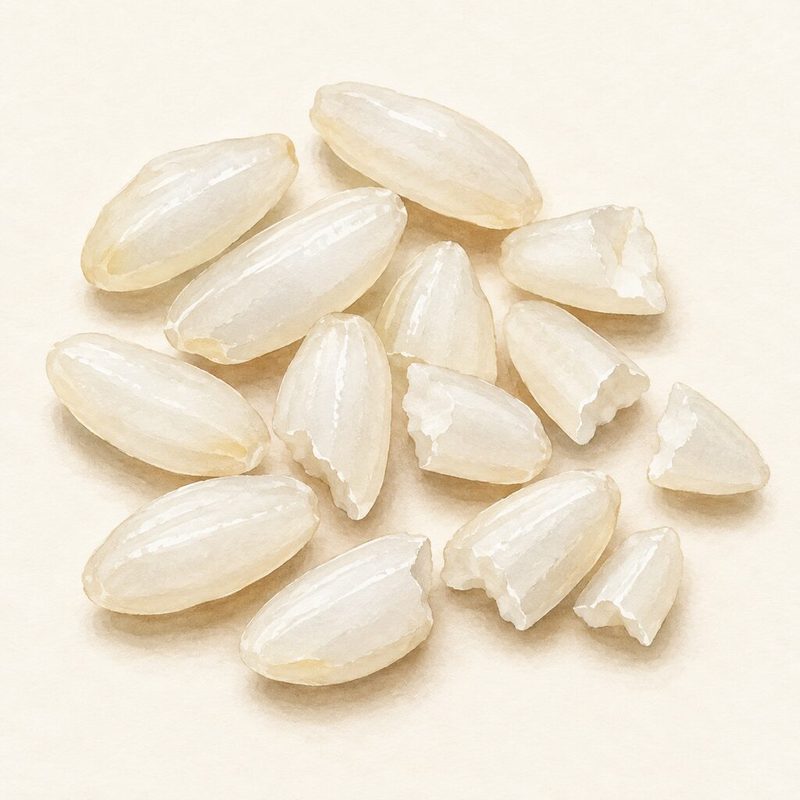
There are three grades, in descending order of quality: “Special” (특), “Superior” (상), and “Regular” (보통). Rice that does not meet the standards, among other cases, is labeled “등외” (below grade).
The grade is determined by the amount of moisture, broken or chipped grains, damaged grains, foreign matter, and other factors in the rice.
For example, the maximum proportion of broken or chipped grains is 3% for “Special,” 7% for “Superior,” and 12% for “Regular.” So the higher the grade, the fewer of these grains are allowed.
Rice in the “Special” grade can also be labeled “완전미” (complete-grain rice) if at least 96% of its grains are “intact grains”—grains that retain an almost complete shape※1. Source: National Agricultural Products Quality Management Service of Korea, “Rice Grade Guide” (in Korean) / National Agricultural Products Quality Management Service of Korea, “Grain Labeling System” (in Korean)
Korea: Protein content categories “수,” “우,” and “미”
Some packages of rice in Korea also show the protein content of the rice after milling.
Korea divides protein content into three categories: 수 (su), 우 (u), and 미 (mi).
“수” is 6.0% or less, “우” is 6.1–7.0%, and “미” is 7.1% or more.
In general, rice with less protein tends to become softer and stickier when cooked. If you like soft, sticky rice, choosing rice with the lower protein category “수” may be one option.
Of course, protein content alone does not determine how good rice tastes, but it may be useful to keep in mind when choosing rice.
In 2025, it was reported that protein content labeling was expected to become mandatory in 2026. However, based on the information I could confirm as of October 2026, it remains voluntary. Source: National Agricultural Products Quality Management Service of Korea, “Grain Labeling System” (in Korean) / Nongmin Newspaper (April 2025, in Korean)
Japan: Grades for brown rice
In Japan, there is a system for inspecting brown rice before milling and assigning a grade according to its quality.
Brown rice intended for everyday consumption is classified as “Grade 1,” “Grade 2,” or “Grade 3.” One of the criteria is the proportion of “whole kernels” (well-formed grains)※2. This grade is related to the condition of the grains in brown rice.
Grade 1 requires 70% or more whole kernels, Grade 2 requires 60% or more, and Grade 3 requires 45% or more. There are also standards for moisture, damaged grains, foreign matter, and other factors. Source: Japan’s Ministry of Agriculture, Forestry and Fisheries, “Inspection Standards for Brown Rice”
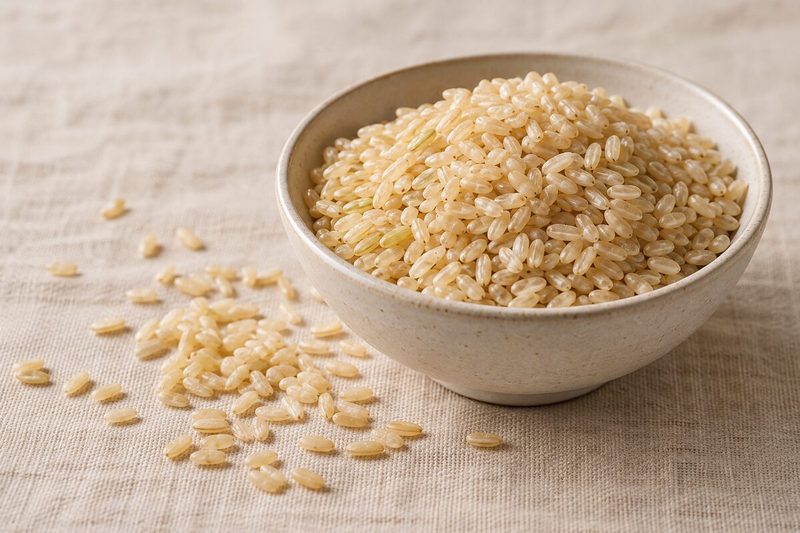
However, these grades do not evaluate how good the rice tastes. They are mainly used to assess brown rice quality, including how much good-quality rice is likely to remain after milling. So Grade 1 rice is not necessarily tastier than Grade 2 rice.
🔷A little more detail
Korea’s “intact grains” and Japan’s “whole kernels” are both standards for assessing the condition of rice grains, but their definitions and the stages at which they are inspected differ. Their percentages therefore cannot be compared directly.
※1Korea’s “intact grains” (완전낟알): After milling, this refers to grains that retain a complete shape or are at least three-quarters as long as the average length of a complete grain. Chalky, damaged, and heat-damaged grains are excluded.
※2Japan’s “whole kernels”: In brown-rice inspection, these are grains other than damaged grains, dead rice, immature grains, foreign grains, and foreign matter.
Japan: Milled Rice JAS
Japan also has quality standards for rice after milling, called the Milled Rice JAS standards. These standards also relate to the condition of the grains after milling.
The standards cover eight items, including whiteness, moisture, broken grains, and damaged grains. For example, broken grains must account for no more than 3%. Products that meet the standards and receive certification can display the “Milled Rice JAS” mark. Source: Japan’s Ministry of Agriculture, Forestry and Fisheries, “About the Milled Rice JAS (Japanese Agricultural Standards)”
※3 From the website of the Japan Polished Rice Inspection and Certification Association
Neither brown-rice grade labels nor the Milled Rice JAS mark are mandatory, so some packages may not display them.
Even so, if one of these labels is shown, it may be a useful reference when choosing rice.
Here is a summary↓
| System | What does it cover? | What is assessed? | Is labeling mandatory? |
|---|---|---|---|
| Korean packaged-rice grade | Milled non-glutinous rice | Moisture, broken grains, damaged grains, foreign matter, and other factors. The maximum proportion of broken grains is 3% for “Special,” 7% for “Superior,” and 12% for “Regular.” The grade is not based solely on the proportion of intact grains. | Grade labeling is mandatory for covered non-glutinous rice, excluding black rice and aromatic rice. |
| Korea’s “complete-grain rice” label | Milled non-glutinous rice in the “Special” grade | The label can be used when at least 96% of the grains in “Special” grade rice are intact grains. | Optional. The package may show “완전미” (complete-grain rice) in addition to the “Special” grade. |
| Korea’s protein-content label | Milled non-glutinous rice | Protein content is divided into “수,” “우,” and “미.” “수” is 6.0% or less, “우” is 6.1–7.0%, and “미” is 7.1% or more. | Optional at present (as of October 2026). |
| Japan’s brown-rice inspection grades | Brown rice before milling | Whole-kernel percentage, moisture, damaged grains, foreign matter, and other factors. For non-glutinous brown rice, Grade 1 requires at least 70% whole kernels, Grade 2 at least 60%, and Grade 3 at least 45%. | Inspection is optional. Not all rice is assigned a grade. |
| Japan’s Milled Rice JAS | Milled short-grain※ non-glutinous rice | Eight items, including whiteness, moisture, foreign matter, colored grains, damaged grains, broken grains, chalky grains, and grains that crack when soaked in water. | Certification is optional. Certified milled rice that meets the standards may display the JAS mark. |
Rice breeding is also advancing in Korea
Varieties developed in Japan, such as Koshihikari and Akibare, are also grown in Korea. In recent years, however, Korea has been advancing its own rice breeding programs, with a focus on taste and ease of cultivation.
For example, in Icheon, Gyeonggi Province, a well-known rice-producing area, efforts have been made to replace varieties developed in Japan with varieties developed in Korea. Two examples are “Haedeul” (해들) and “Alchanmi” (알찬미). Koshihikari, which had been grown there, is being replaced by Haedeul, and “Akibare” (Korean name: 추청) by Alchanmi. Source: National Institute of Crop Science of Korea (in Korean)
According to information published by Korea’s Rural Development Administration in January 2026, Korea has selected 11 “top-quality rice varieties,” including the newly added “Sugwang 1” (수광1). Haedeul and Alchanmi are among them.
The results of rice breeding can also be seen in the figures. In a 2025 milling evaluation, the new variety Sugwang 1 had an intact-grain rate of 96.3%—higher than the 93.4% recorded for the earlier variety Sugwang. Rice breeding is also progressing in Korea, with the aim of producing higher-quality rice. Source: Korea’s Rural Development Administration (January 27, 2026, in Korean)
How to choose good-tasting rice in Korea
Now let’s look at which details on a rice package you can check when buying rice in Korea.
As in Japan, packages show information such as the variety, harvest year, milling date, and quality grade. The labels are in Korean, of course, but learning a few words can make it easier to choose rice.
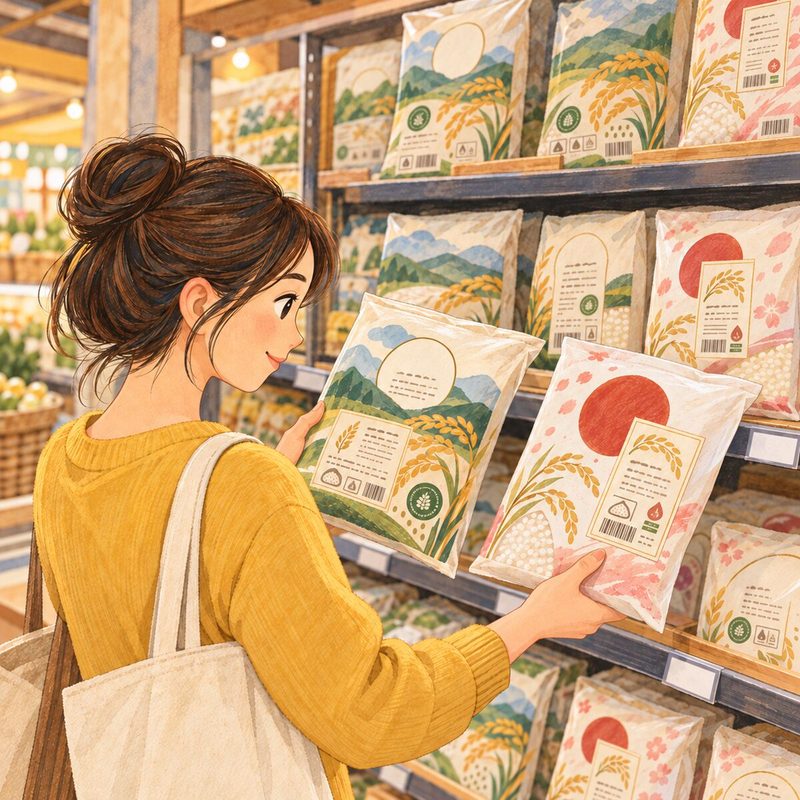
1. Variety (품종 / pumjong)
The first thing to check is 품종 (pumjong), or the rice variety. Some packages name a specific variety, such as Koshihikari (고시히카리), Alchanmi (알찬미), or Haedeul (해들).
Rice made by blending several varieties may also be labeled 혼합 (honhap), meaning “mixed.” If you make a note of the variety you like, it will be easier to find it again next time.
Keep in mind that Korea’s 단일미 (danilmi), or single-variety rice, and Japan’s “single-origin rice” are labeled under different conditions. For details, see “How do rice variety labels differ in Japan and Korea?” above.
2. Harvest year (생산연도 / saengsanyeondo)
생산연도 (saengsanyeondo) means the year the rice was harvested. It can also help you tell whether the rice is “new rice,” as the term is used in Japan.
However, rice harvested the previous year is not necessarily less tasty. Quality also depends on storage conditions, so it is a good idea to check the milling date, which I’ll explain next.
3. Milling date (도정연월일 / dojeongnyeonworil)
도정연월일 (dojeongnyeonworil) is the date when the rice was milled.
Rice can gradually lose some of its flavor over time after milling. If you are choosing between rice of the same variety and grade, one option is to pick the package with the more recent milling date.
4. Grade (등급 / deunggeup)
등급 (deunggeup) means the quality grade of the rice. In descending order, the grades are 특 (teuk, Special), 상 (sang, Superior), and 보통 (botong, Regular). Rice that does not meet the standards is labeled 등외 (deungoe, below grade). Some rice in the 특 grade also carries the additional label 완전미 (wanjeonmi, complete-grain rice). For details, see “How is rice quality managed? Standards and labeling in Japan and Korea.”
5. Country or region of origin (원산지 / wonsanji)
원산지 (wonsanji) means the rice’s country or region of origin. If you see 국산 (guksan), it means the rice was produced in Korea. Some packages also show the name of the region where the rice was grown.
For example, Icheon (이천) is well known in Korea as a rice-producing area. You may want to use the region as one of the things to consider when choosing rice.
However, rice from a well-known region is not necessarily always delicious. It is worth checking the variety, harvest year, milling date, and grade as well.
Optional label: Protein content (단백질함량 / danbaekjil hamnyang)
As mentioned earlier in “How is rice quality managed? Standards and labeling in Japan and Korea,” some Korean rice packages also show the protein content.
The protein content is divided into three categories: 수 (su), 우 (u), and 미 (mi).
This label is currently optional, so some packages do not show it.
Rice packages I found in Korean supermarkets
Here are some photos of rice packages I took in Korea. The labels differ from product to product, including Koshihikari, rice from Icheon, and blended rice. These photos show the products as they appeared when I took them, so the products or labels currently on sale may be different.


Learning these five words—variety (품종), harvest year (생산연도), milling date (도정연월일), grade (등급), and country or region of origin (원산지)—can make Korean rice packages easier to understand.
How to cook Korean rice
The way rice is cooked can make a difference, too—not just the way you choose it.
Start with the rice cooker’s water markings
Some people say that you should use more water when cooking Korean rice than Japanese rice. In practice, however, the right amount of water also depends on the variety and condition of the rice and on the type of rice cooker.
So you do not need to add extra water from the start just because the rice is Korean. First, cook it according to the markings in your rice cooker. If it seems too firm, add a little more water next time; if it seems too soft, use a little less. Adjusting it to your own preference is a good approach.
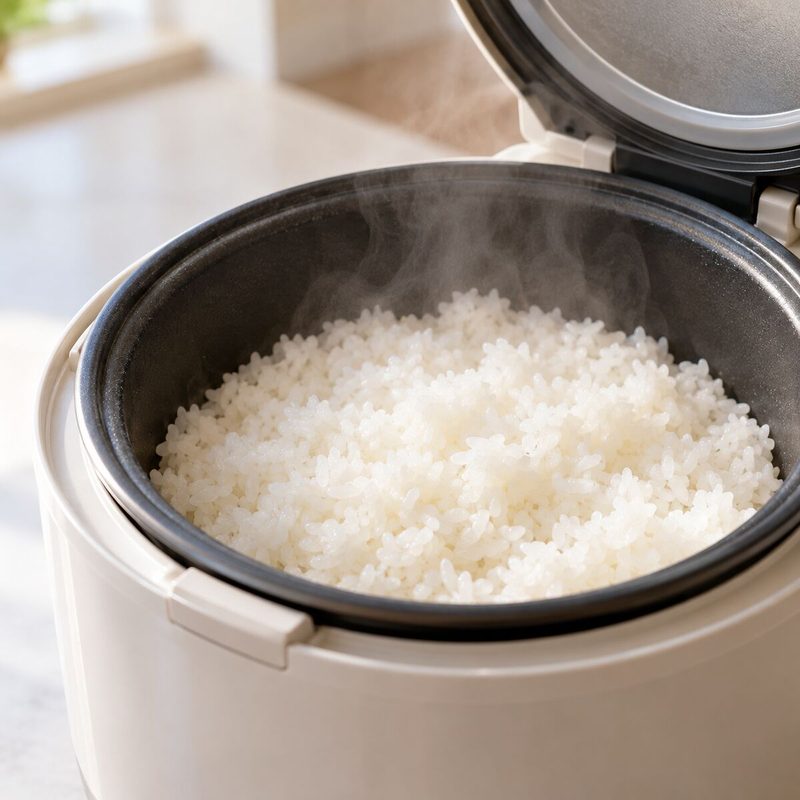
It is also important to let the rice absorb enough water before cooking. If you are cooking it in a pot, soaking it for 30 minutes to an hour is one general guideline. Some newer rice cookers include a soaking stage, though, so follow the instructions for your model. Source: Japan’s Ministry of Agriculture, Forestry and Fisheries, “How to Enjoy Delicious Rice Starting Today”
As for me, I like my rice on the firm side. Whatever kind of rice I use, I find that adjusting the water to my liking makes it taste better.
WowKorea also has an article about how to cook Korean rice. However, not all Korean rice has less moisture than Japanese rice. It seems best to cook it normally first, then adjust the water to your liking. WowKorea article
Store rice in a cool place
Even good rice can lose its flavor if it is not stored properly. Milled rice gradually changes in quality over time, so it is best to avoid storing it for long periods. If possible, buy an amount you can finish in about a month, seal it in an airtight container, and keep it in a cool place.
During hot weather, storing rice in a clean, airtight container in the vegetable drawer of the refrigerator is another good option. Summers in Korea are hot and humid, too, so it is worth paying attention to where you store the rice to enjoy it at its best. Source: Minna no Nōgyō Hiroba, “Rice Storage”
Summary: Choose Korean rice by checking the package
When buying rice in Korea, checking the variety, harvest year, milling date, grade, and place of origin on the package can help you choose. Japan and Korea use different systems to show and assess rice quality, so knowing what each label means can be useful when comparing products.
When cooking, start with the rice cooker’s water markings and adjust the amount to get the texture you like. To help preserve the rice’s flavor, seal it and store it in a cool place.
It can be fun to compare varieties and labels when choosing rice in Korea. I’m looking forward to trying different kinds of rice here. As I think back fondly on the rice fields in Fukuoka, I’ll enjoy another good bowl of rice in Korea today.
References
- Rice Labeling (Ministry of Agriculture, Forestry and Fisheries of Japan)
- Inspection Standards for Brown Rice (Ministry of Agriculture, Forestry and Fisheries of Japan)
- About the Milled Rice JAS (Japanese Agricultural Standards) (Ministry of Agriculture, Forestry and Fisheries of Japan)
- How to Enjoy Delicious Rice Starting Today (Ministry of Agriculture, Forestry and Fisheries of Japan)
- Rice Storage (Minna no Nōgyō Hiroba)
- Korean Rice: What Types Are There, and How Can You Cook It Well? (Korea) (WowKorea)
- 쌀·현미의 품종 표시사항 중 다른 품종의 혼입허용범위 (Permitted proportion of other varieties under the variety-labeling requirements for rice and brown rice) (Ministry of Agriculture, Food and Rural Affairs Notice No. 2020-31, 2020, in Korean)
- 양곡표시제 (Grain Labeling System) (National Agricultural Products Quality Management Service of Korea, in Korean)
- 쌀 등급 알리미 (Rice Grade Guide) (National Agricultural Products Quality Management Service of Korea, in Korean)
- Information on Haedeul and Alchanmi in Icheon (National Institute of Crop Science of Korea, in Korean)
- Information on Top-Quality Rice Varieties, Including Sugwang 1 (Rural Development Administration of Korea, January 27, 2026, in Korean)
- Tasty, High-Quality Gyeonggi Rice That Won Over the King’s Palate (Gyeonggi Province, November 4, 2024, in Korean)
- Article on “Single-Variety” and “Mixed” Rice Labels (Kids Hankook Ilbo, 2024, in Korean)
- Protein Content Labeling for Rice to Become Mandatory: Aiming for Higher Quality and Supply Control (Nongmin Newspaper, April 2025, in Korean)
